AI marks the spelling so your child's teacher can mark ideas
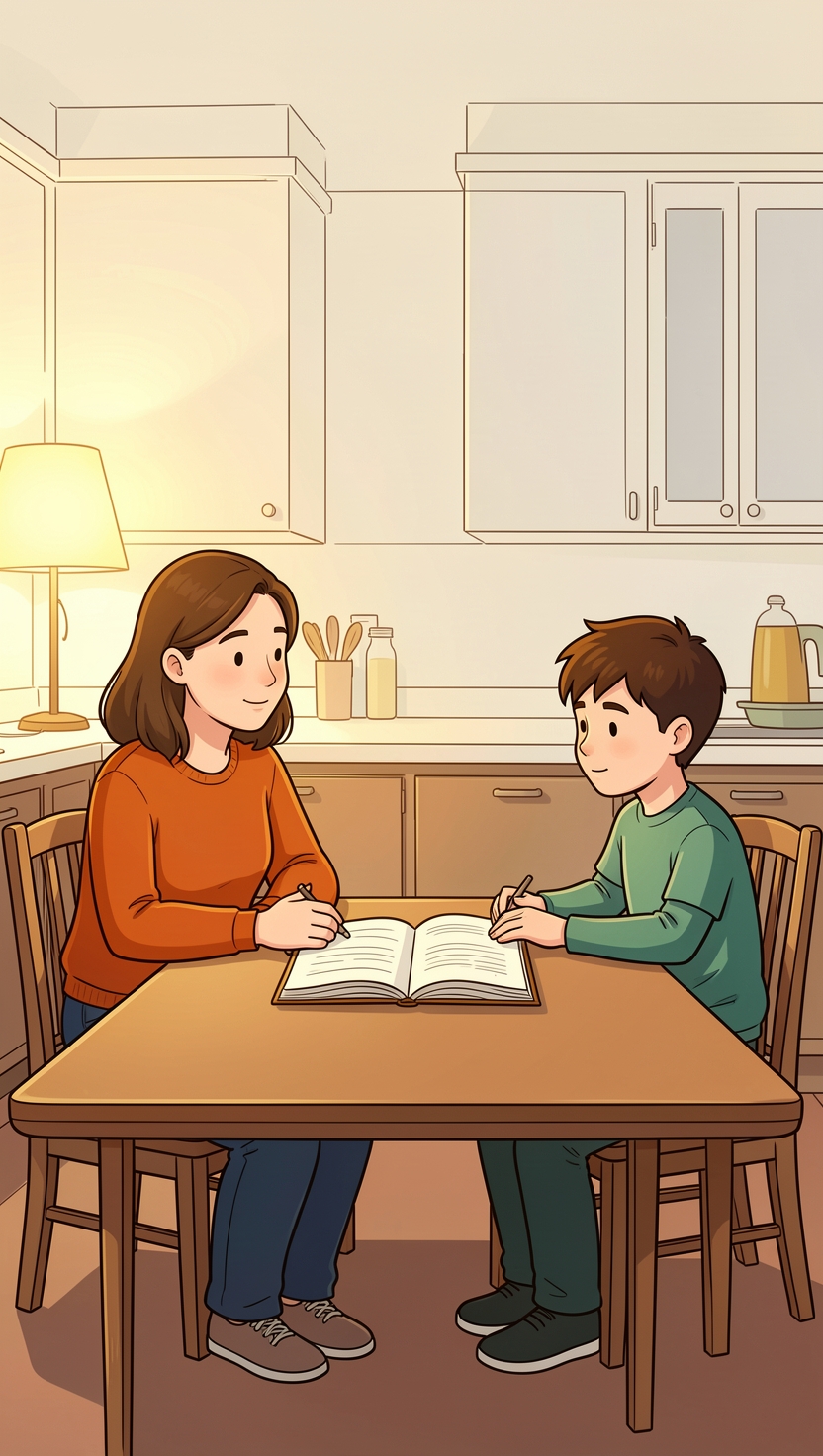
Ask a teacher why children do not write more, and the answer is almost never that children hate writing. It is that somebody has to read it. Thirty compositions, each with its own knot of tenses and spellings, is an evening gone, and the comments land three days after the child stopped caring about the story.
In Singapore, a slice of that job has quietly moved to a machine.
What the machine actually does
The Ministry of Education’s Student Learning Space now runs a small family of AI feedback tools, and MOE publishes what each one is for. The Short Answer Feedback Assistant gives “suggested marks and auto-generated feedback for free-response questions”. The Annotated Feedback Assistant embeds comments in the child’s own answer “via annotation cards”. The maths one offers “step-by-step hints and feedback to students’ workings”. There is also a Speech Evaluation Tool for pronunciation and fluency, which we wrote about in Singapore’s school AI that listens.
The English one is the plainest of the lot. The Straits Times, reporting in 2024 on three feedback assistants launched in 2023, put it like this: “The English language version corrects grammar, spelling and sentence structure, while the short answer assistant corrects answers across subjects such as geography and science, freeing up teachers to assist with more challenging content.”
Then there is LEA, the Learning Assistant, described by MOE as a “dialogic agent on SLS, which serves to guide students’ learning via iterative questioning”. In its 6 May 2026 parliamentary reply on AI in schools, MOE gave composition writing as the worked example: a Primary 4 English class using LEA to improve a draft, with the guardrail that “the LEA will redirect students back on track if they veer off-topic and ask irrelevant questions, or if they want to be spoon-fed”.
Singapore drew this line in 2021, before it was fashionable
In November 2021, Dr Tan Wu Meng asked in Parliament about safeguards for automated marking of English assignments, worried it would flatten the creativity and personality in a child’s writing. MOE’s answer was not that the machine is clever. It was that the machine is narrow. Educational technology “aims to complement, and not dilute our teachers’ central role”, the reply said; the English assistant gives feedback “on areas such as spelling and grammar”, which frees teachers for the “higher-level skills like creative expression”. Instant correction of basic errors, MOE argued, means children write more often and it “allows them to devote more effort on more demanding aspects like creative expression”.
That is a claim about division of labour, and it is testable. So what does the research say?
The gain is real, and it lands somewhere unexpected
A 2023 multi-level meta-analysis in Frontiers in Artificial Intelligence by Johanna Fleckenstein, Lucas Liebenow and Jennifer Meyer pooled 20 studies (84 effect sizes, 2,828 participants) and found a medium positive effect of automated feedback on writing performance, g = 0.55. Secondary students (0.50) and university students (0.58) were not meaningfully different.
The interesting result is buried in the moderators. When the outcome was revising the same text, the effect was 0.27 and not significantly different from zero. When the outcome was a new piece of writing, it was 0.65 and significant. The authors read that as evidence that automated feedback “does have an impact on learning to write rather than on situational performance enhancement”.
Sit with that for a second, because it changes what a parent should look at. The corrected draft is not the evidence. The next composition, written without the tool, is.
A second 2023 meta-analysis, by Na Zhai and Xiaomei Ma in the Journal of Educational Computing Research, covered 26 studies and 2,468 participants and reported a larger overall effect on writing quality (g = 0.861), with bigger benefits for students writing English as a second or foreign language than for native speakers. The two analyses disagree on the size of the prize, which is normal and worth saying out loud, but they agree on the direction. And if your child writes in English at school and speaks mostly something else at home, that second-language finding is the one to read twice.
What it still cannot do
A systematic review published in Frontiers in Education on 25 June 2026 looked at 34 classroom studies of large language model feedback across 19 countries. It found gains in “writing productivity, linguistic accuracy, engagement, and feedback literacy, particularly by enabling rapid and iterative revision”, and strong performance on “structural and mechanical problems”. It also found the machine did not adequately address “argument development, contextual interpretation, prioritization of revision needs, and dialogic guidance”, and that human feedback was still better at making clear what to actually change.
Two caveats sit on top of all this. Of those 34 studies, 29 were at university level and exactly one was in an elementary classroom, which is why the reviewers tell practitioners in primary and secondary settings to “exercise caution in applying these findings” and call the evidence “indicative rather than conclusive”. And the marking is not free of the teacher: The Straits Times reported that the time savings are not fully realised because teachers still review the machine’s feedback by hand, with one junior college physics teacher noting the AI can misjudge a response.

The question to ask at home
Our view, offered as a view: the design here is right, and it is right for an unglamorous reason. Spelling and syntax are the part of writing a machine can genuinely judge, and the part a child can practise endlessly without embarrassment. Handing it over is not the AI teaching your child to write. It is clearing the desk so somebody can.
So when the marked draft comes home covered in tidy corrections, resist grading it. Ask instead whether your child can say, in their own words, why the sentence was wrong. Then wait for the next piece and read that one properly, because that is where the research says the difference shows up. At the parent teacher meeting, the useful question is not whether the school uses AI. It is which assistant is switched on for English, and whether the child is writing more since it was.
The machine can tell a child that a sentence is broken. It cannot tell them the sentence is boring. Whoever does that job is still the one teaching them to write.
Disclosure: Mentus AI builds AI mentors for children, so we have a commercial interest in this subject. It is also why we are strict about what the evidence does and does not show.
Was this useful?
Sources
- AI-enabled Features on the Student Learning Space · Ministry of Education, Singapore
- AI usage in schools (Parliamentary Reply, 6 May 2026) · Ministry of Education, Singapore
- Automated Marking System (Parliamentary Reply, 3 November 2021) · Ministry of Education, Singapore
- Automated feedback and writing: a multi-level meta-analysis of effects on students' performance · Frontiers in Artificial Intelligence
- The Effectiveness of Automated Writing Evaluation on Writing Quality: A Meta-Analysis · Journal of Educational Computing Research (via ERIC)
- Large language models for formative feedback in writing instruction: a systematic review of classroom interventions, feedback quality, and student outcomes · Frontiers in Education
- MOE's newest AI tools and how schools are using them · National Institute of Education, NTU Singapore (originally The Straits Times)