PSLE maths and the AI that reads your child's working
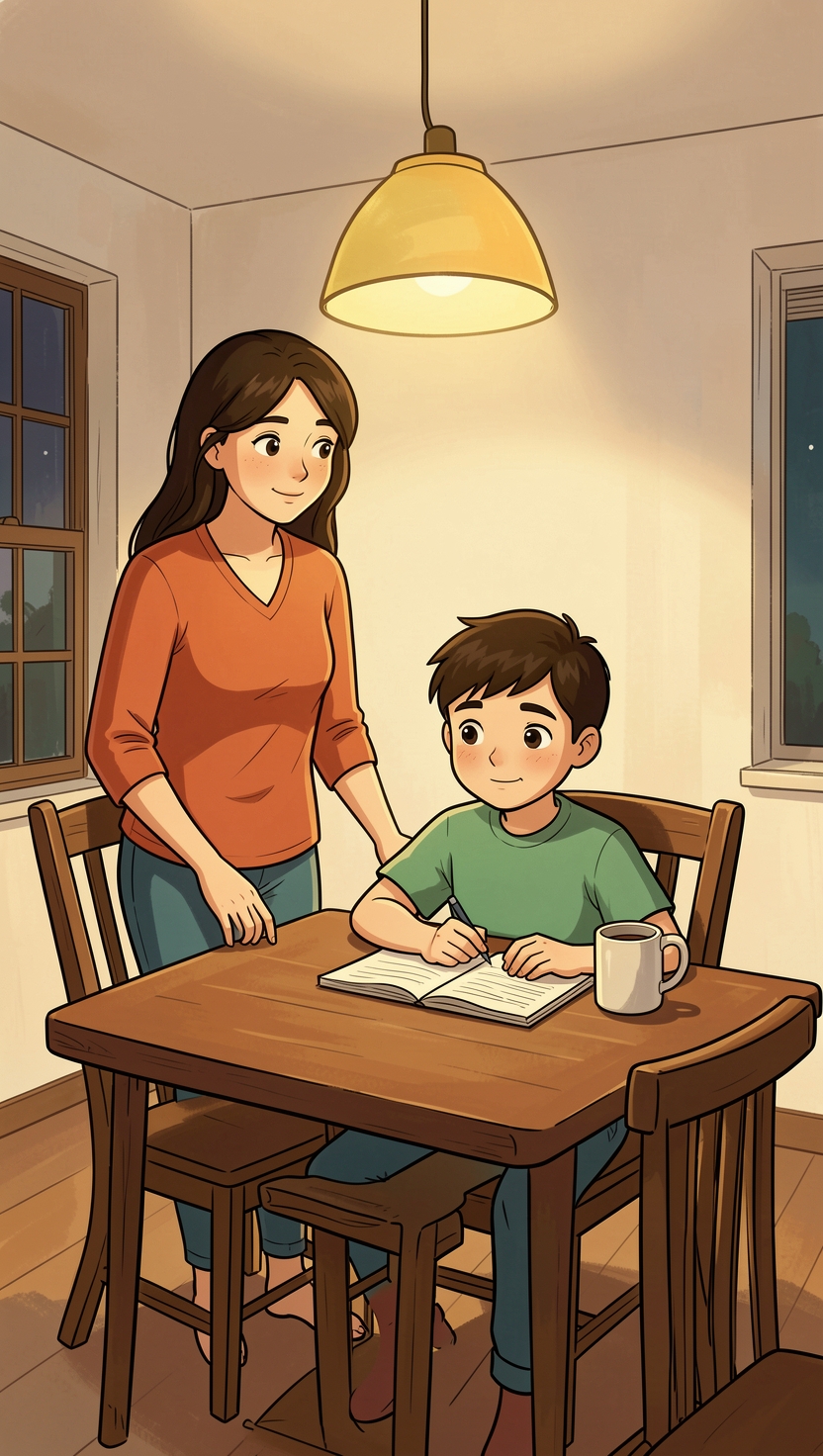
It is nine o’clock and there is one question left. Your Primary 5 child has drawn a bar model, divided something by four, and arrived at an answer that is wrong. You can see it is wrong. What you cannot see, standing behind the chair with a mug going cold, is where it stopped being right.
The quickest way out of that moment is a photograph and a chatbot, which will hand back four tidy lines and a number. The slowest way out is asking the child to talk you through it. Singapore’s own exam rules are, oddly, an argument for the slow way.
The exam pays for the route, not just the destination
The PSLE Mathematics syllabus SEAB publishes for the 2026 examination is unusually blunt about this. On a short-answer question with one part, two marks go to the correct answer, and then: “If an incorrect answer is given, 1 mark is awarded for the correct method.” On the long questions, the instruction to the child is that “a candidate has to show his method of solution (working steps) clearly and write his answer(s) in the space(s) provided.”
Those long questions are not a footnote. The examination runs to 45 questions and 100 marks, and ten structured questions carrying 3, 4 or 5 marks each account for 40 of them. The third assessment objective asks pupils to “reason mathematically; analyse information and make inferences; select appropriate strategies to solve problems”.
So the system already knows what it is buying: the middle of the page. A tool that supplies a finished answer removes precisely the part being marked, and does it in a way that looks, at 9pm, like help.
What MOE actually built, and what it deliberately is not
The AI in Singapore’s Student Learning Space for maths is not a chatbot. Feedback Assistant Mathematics, in MOE’s own description, “offers step-by-step hints and feedback to students’ workings, and suggested marks”, and the page says plainly that “FA-Math is a rules-based engine”. Not a language model, which makes it duller and a great deal more predictable.
The student guide is where the design shows. A child can “choose to type or write your response”, handwriting on a touchscreen or using a keyboard with a formula editor. On bar model questions the instruction is to “Label your model and type your calculations in the space provided” and then press Check. It looks at the steps, because it was built for a marking culture that pays for method.
When The Straits Times reported on the assistants in 2024, in a piece republished by NIE, an MOE officer described the maths tool as “guiding students through their answers rather than just checking the final result”. A teacher quoted in the same article gave the caveat: the AI may not always assess responses accurately, can make errors, and still needs manual review. Which is the honest version, and worth keeping.
The evidence is real and it is small
Two recent syntheses put a number on this. Neither is thrilling.
A 2025 systematic review and meta-analysis in the International Journal of Science and Mathematics Education pooled 21 studies and 40 samples of AI in K-12 mathematics and found “a small overall effect size of 0.343” in favour of AI, with the larger effects where the AI was an intelligent tutoring or adaptive learning system. A November 2025 preprint by Walter Leite and colleagues, covering 18 American studies and 77 effect sizes across 11 tutoring systems, landed lower still at g equals 0.271, similar for primary and middle school and similar for low-achieving students. Their modelling put worked-out examples, how long the tool was used and the kind of outcome measured among the strongest moderators.
Small but real, in other words. Our read: this is a worksheet that answers back, not a private tutor. Treat anyone selling it as the second thing with suspicion.
Olympiad gold, and still bad at reading a nine-year-old’s page
Here is the gap that should shape what you let the machine do.
In July 2025 Google DeepMind announced that an advanced version of Gemini with Deep Think had officially reached gold-medal standard at the International Mathematical Olympiad, solving five of six problems for 35 points, and doing it “end-to-end in natural language, producing rigorous mathematical proofs directly from the official problem descriptions”. These models are extraordinarily good at generating mathematics.
Now the other result. In a March 2026 preprint, researchers ran 11 vision-language models over DrawEduMath, a benchmark built from real children’s handwritten and hand-drawn maths work, across a year of model releases. Their finding is uncomfortable and specific: “All evaluated VLMs underperform when describing work from students who require more pedagogical help, and across all QA, they struggle the most on questions related to assessing student error.” The authors conclude that while these models “may be optimized to be math problem solving experts”, supporting education needs different incentives.
Read those two together. The machines are best at the thing your child must do alone, and worst at the thing you actually wanted, which is to be told where the working went wrong, for the child who is struggling most. That is a preprint and the field moves quickly, so hold it loosely.
What to do with the last question of the night
Ask the maths teacher at the next meeting whether Feedback Assistant Mathematics is switched on for your child’s assignments. It is already sitting in SLS, and it is easy to forget it exists.
At home, change the order of operations. The working goes on the paper first, in the child’s own hand, before anything is typed into anything. If you do use a chatbot, ask it to find the first wrong step rather than to solve the problem, and then treat its verdict as a guess you still have to check, because that is the exact task the research says it is weakest at. Then ask your child to explain the step out loud. If they cannot say why, the mark was never theirs.
We build AI mentors for a living, so read that as an interested party talking. It is also why we would rather a tool asked your child where the four came from than told them. Our earlier piece on how AI marks spelling while teachers mark ideas makes the same argument from the English paper.
The question at 9pm is not “is this right”. Your child can see it is not right. The question is “which line stopped being true”, and answering that is the whole subject.
Was this useful?
Sources
- PSLE Mathematics (0008) syllabus, for examination from 2026 · Singapore Examinations and Assessment Board
- Feedback Assistant Mathematics · Ministry of Education, Singapore (Student Learning Space)
- About Feedback Assistant Mathematics (Enhanced), student user guide · Ministry of Education, Singapore (Student Learning Space)
- MOE's newest AI tools and how schools are using them · National Institute of Education, NTU Singapore (from The Straits Times)
- The Effectiveness of AI on K-12 Students' Mathematics Learning: A Systematic Review and Meta-Analysis · International Journal of Science and Mathematics Education (via ERIC)
- Do intelligent tutoring systems benefit K-12 students? A meta-analysis and evaluation of heterogeneity of treatment effects in the U.S · arXiv preprint
- The Aftermath of DrawEduMath: Vision Language Models Underperform with Struggling Students and Misdiagnose Errors · arXiv preprint
- Advanced version of Gemini with Deep Think officially achieves gold-medal standard at the International Mathematical Olympiad · Google DeepMind